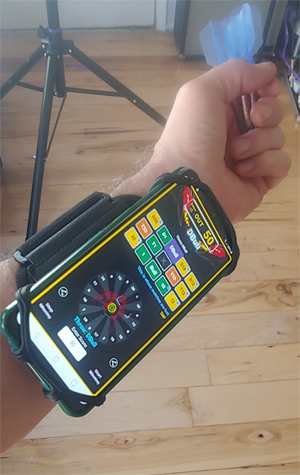
56 Checkout in Darts — 16, D20
From 56, most of the decision-making is already complete before stepping to the oche. The route — 16 → D20 — is clear, the target is reachable, and the double is in front of you. The challenge is not strategic or positional. It is the ability to execute 16 and then D20 in sequence without allowing the proximity of the finish to change the quality of the throw. Players who over-perform at low scores in practice and under-perform in matches are usually responding to the finish rather than throwing to it.
The miss geometry on the opening dart favours the 8 side. A drift from 16 in that direction leaves 48 — 16 → D16, which preserves a working route. The 7 side produces 49, a harder position to continue from. That asymmetry is useful information: the pre-throw setup can subtly bias the release toward the 8 side without altering the fundamental mechanics of the throw. Knowing which direction is the preferred miss before stepping to the oche removes a decision that would otherwise be made reactively — and reactive decisions under pressure rarely favour the better outcome.
The decision about which route to use from 56 should be made before stepping to the oche — not at it, and not during the visit. Arriving at the line already having chosen 16 → D20 removes an entire category of thought from the throw. Players who are still weighing options as they step forward introduce a kind of cognitive load that does not appear in practice but is consistently present in match conditions. Deciding the route in advance and committing to it completely is the structural version of pressure management — it reduces the number of decisions that need to be made while throwing.
Consistent finishing in darts depends on mental control as much as technique — and mental control, like technique, is trainable through structured practice. The key on 56 is balance between scoring and positioning for the finish. Overcommitting on one dart often creates unnecessary pressure on the next. The most important moment in finishing 56 is not the throw itself — it is the decision to commit made before the throw begins. The dart responds to the mechanics of the throw. Keep those mechanics consistent and pressure becomes irrelevant to the outcome. The moment between stepping to the oche and beginning the throw is where pressure is managed. Use that moment deliberately — breathe, grip consistently, commit.
Against an opponent who can win next visit, the comfort of arriving at D20 through a controlled route is significant. This is the double to be on when the match is on the line.
Route Comparison & Target Selection
Primary: 16 → D20
single 16, closing on double 20 — high-percentage close
Alternate: 8 → 8 → D20
single 8, single 8, closing on double 20 — high-percentage close — no triple required on opener
Two distinct approaches are available from 56. The primary (16 → D20) takes the aggressive line — 16 on the opening dart applies real scoring pressure and leads into D20 as the close. The alternate (8 → 8 → D20) opens on 8, a wider target that removes the need for triple precision. The leg still closes on D20. The distinction is match-contextual: the primary is for tight legs and pressing situations; the alternate is for comfortable leads where protecting the route is more important than maximising first-dart scoring. Neither route is a fallback — both are deliberate choices for defined situations.
The anti-target on 16 is 7. A miss there leaves 49 — the preferred miss is into 8 for 48.
Miss Geometry, Route Structure & When to Use the Alternate
Opening on 16 here means the first dart does not require triple precision. The single segment covers the full scoring area and the miss cost is lower than any triple opening would carry. From 56 this controlled start is what the route structure calls for — not because a triple is unavailable, but because 16 leads into the correct leave for the close more reliably than any triple alternative. Players who override this structure and attempt a triple-first approach from 56 typically arrive at the close from a weaker, less predictable position. Beyond the opening dart geometry, 56 breaks into a two-dart finish: 16 → D20. The directness of the route is both its strength and its demand. 16 must land in the right place to set up D20, and there is no third dart available to correct a mistake between the two. What makes two-dart routes particularly consequential in match play is the visibility of the recovery: both players immediately know whether the first dart has created the close or left a harder problem. That visibility is the pressure unique to two-dart finishes, and the correct response to it is full commitment to the target, released at consistent arm speed. For the alternate option, the alternate route (8 → 8 → D20) removes the triple requirement on the first dart, starting on 8 rather than 16 to arrive at the same close on D20 through a wider, lower-risk path. When ahead by enough that protecting the leg is the priority over pressing, this is the route to use. When the match is close and scoring pace carries strategic weight, the primary is correct. The alternate is not a conservative fallback — it is a specific tool for a specific match situation, and using it at the right moment is a competitive skill rather than a concession.
When and Why to Use This Route
Apply this route when the close matters most. D20 is the strongest double this route can offer and the path to it through 16 is controlled enough to reproduce across visits, even when pressure builds.
The route works because control through the setup produces a better close than aggression does. An aggressive opener might score more on the first dart, but it creates more tension and more variability in the approach to the close. 16 creates less of both. D20 is the destination and this route provides the most reliable path to it.
Why Players Miss This Finish
Players miss 56 through route abandonment. The original plan — 16 → D20 — is correct. A slightly off first dart changes the leave in a small way, and the player decides mid-visit to improvise rather than read the new score and continue with the adjusted route. That improvisation introduces a dart thrown to a target that was chosen quickly rather than correctly. The miss almost always comes from the improvised dart, not the original miss. Players who read their actual leave after every dart and continue with the best available path from there close 56 significantly more often than those who try to recover the original route after a drift.
The fix is specific: before stepping to the oche on 56, decide the full route, decide the preferred miss direction on 16, and commit to both before throwing the first dart. Players who make these decisions at the line rather than before it are making them while moving — which means they are made reactively rather than deliberately. A decision made before the approach is a decision that holds under pressure. A decision made mid-approach changes the throw.
Practice
Practise the 56 checkout by running 16 → D20 as a complete two-dart sequence rather than throwing each dart separately. The transition between 16 and D20 is where two-dart routes most often break down — a good opener creates expectation about the close, and that expectation sometimes changes the throw on D20 in exactly the wrong direction. Run the sequence clean five times. If the break is consistently on the second dart, practise D20 in isolation for a set, then reintegrate it into the full route.
Include recovery reps in every 56 practice session. When 16 drifts into 8, the leave is 48 — practise that score until it feels routine, because it is the most likely leave after an imperfect first dart. When 16 drifts into 7, the leave is 49 — that one deserves practice too, because a leave that has never been practised becomes a source of hesitation in a match. Building familiarity with both miss outcomes means the visit continues automatically rather than stalling after a drift on the opener.