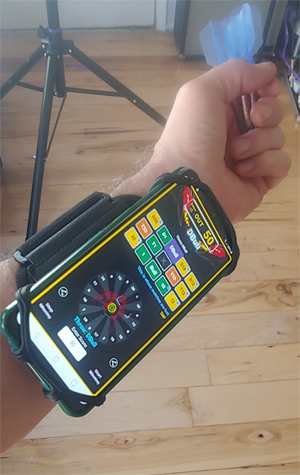
141 Checkout in Darts — T20, T19, D12
141 is one of the high-value finishes in 501 — a score where the first dart needs to carry both precision and commitment from the moment it leaves the hand. The route runs T20 → T19 → D12, closing on D12, which is among the best finishing doubles on the board. From this score, the margin for error on the opening dart is narrow: a clean T20 keeps the route fully intact, while a slight miss forces an immediate decision about the best available continuation.
The preferred miss direction on T20 from 141 is toward 5. Landing there leaves 136 — a position that still carries a realistic path to the close. The 1 side leaves 140 and a harder problem. Players who pay attention to miss geometry on their primary scoring targets consistently produce better outcomes from imperfect darts, which is where most of the marginal gains in competitive 501 are actually found — not in perfect throws, which are the same for everyone, but in where the imperfect ones land.
Players who are reliable at finishing 141 in competition have usually identified and eliminated one specific failure pattern from their game: the tendency to respond to what just happened rather than commit to what comes next. If the first dart misses, the instinct is to adjust — to be more careful, to aim more precisely, to compensate. That instinct is the source of most dropped legs on 141. The route provides the continuation from any reasonable first-dart outcome. Trusting the route rather than overriding it mid-visit is the discipline that converts practice form into match results.
The throw fails under pressure when timing changes — not when aim changes. That distinction matters because it points directly to the fix. The routine before the throw matters as much as the throw itself. A consistent pre-throw process delivers a consistent throw regardless of what is riding on it. Finishing 141 reliably in match play is a trainable skill. Players who build it deliberately — through structured pressure practice rather than hoping for composure — outperform those who rely on natural calm. At 141, the most reliable approach is not the most aggressive one. It is the most consistent one. The player who holds the same tempo through all three darts wins the leg. Pressure at 141 creates one specific temptation: to do more. More care, more deliberation, more force. All of it produces the miss it was trying to prevent.
With the opponent on a finish, T20 from 141 carries double weight — it scores efficiently and tells the opponent that this leg is not over. D12 as the close is the ideal target to be arriving at under those conditions.
Route Comparison & Target Selection
Primary: T20 → T19 → D12
treble 20 (60), treble 19 (57), closing on double 12 — high-percentage close
Alternate: T19 → T20 → D12
treble 19 (57), treble 20 (60), closing on double 12 — high-percentage close
The primary (T20 → T19 → D12) and alternate (T19 → T20 → D12) are structurally comparable routes from 141 — similar approaches, similar close quality. The miss geometry on T20 is asymmetric — the 5 side leaves 136 and the 1 side leaves 140, so the preferred drift direction is toward 5. Use the primary as the default. Switch to the alternate when the primary's opening is not grouping correctly on a given visit. The comparable close means the switch does not trade close reliability for a different approach — it exchanges one route for another of equal standing.
On 141, 1 is the anti-target. Drifting into it leaves 140 rather than the more manageable 136 from 5.
Miss Geometry, Route Structure & When to Use the Alternate
The geometry around treble 20 is the most punishing on the board for missed triples. The 5 and the 1 sit either side of it — neither useful as a recovery segment from 141. A miss left into 5 leaves 136; a miss right into 1 leaves 140. The route opens on treble 20 because the scoring efficiency justifies it when the darts are landing in the bed. When they are not — when grouping drifts low consistently — switching to treble 19 corrects the geometry. The 3 and 7 that flank the 19 score more than the 5 and 1, and more often leave a position from which the leg can still be closed cleanly. That structural upgrade is the reason the switch is taught as a deliberate skill, not a fallback. Making the decision before stepping to the oche, and executing it with full commitment, is the competitive standard. Beyond the opening dart geometry, from 141 the route needs three darts: T20 → T19 → D12. T20 is the scoring dart, T19 is the positioning dart, and D12 is the close. That structure exists because the score does not allow a shorter path. The positioning dart (T19) is particularly critical: arriving at D12 in control of the close requires that T19 lands exactly where the route requires, not approximately there. Understanding why each dart appears in the sequence — rather than treating the route as a single action — is part of executing three-dart finishes reliably in competitive play. For the alternate option, the alternate (T19 → T20 → D12) and the primary (T20 → T19 → D12) are both genuine routes from 141 — they reach the close through different approaches and comparable finishing doubles. The alternate is not a lesser option; it is a different structural line that may suit the throw better on specific visits. Default to the primary and use the alternate when the primary's sequence — particularly the opening dart at T20 — is not landing as the route requires.
When and Why to Use This Route
This route is correct whenever this score appears. The decision has already been made — T20 into D12 is the route, and the job is to execute it. There is no tactical calculation left to do at the oche.
The strength of this route is that it does what the best checkout routes always do: solves two problems at once. It scores efficiently enough to maintain pace and finishes on a double forgiving enough to close under pressure. T20 handles the first problem. D12 handles the second. Neither dart is a weak link.
Why Players Miss This Finish
Players miss 141 because they bring a two-dart mindset to a three-dart route. When T20 lands well, the impulse is to jump mentally to the close — to start aiming at D12 before T19 has landed. That forward projection reduces the quality of T19 in exactly the same way that thinking about the result of any throw reduces the quality of that throw. The fix is discipline on the middle dart: throw T19 as its own complete decision, with the same focus given to T20, and only then address D12.
Improving on 141 in competition comes from accepting that the throw will not always be perfect and building an automatic response to imperfection. The players who drop this score are usually players who need everything to go right. The players who close it are the ones who have practised enough variants of the route — clean first dart, slightly off first dart, both miss directions — that the visit runs on autopilot regardless of the opening outcome.
Practice
Build the 141 checkout through the middle dart. T20 and D12 receive most of the practice attention in most players' routines — T20 because it opens the visit and D12 because it closes it. But on 141, T19 is usually where the leg is won or lost. A clean T20 that is followed by a slightly rushed T19 leaves D12 from a weaker position than the route intended. Give T19 deliberate practice in isolation — it is the least-practised dart in most three-dart routes and the one that determines whether the close is routine or difficult.
Add consequence to the end of every 141 practice block. After completing the route a set number of times cleanly, throw T20 deliberately off-line and practise continuing from 136 and 140 without resetting. This forces the continuation habit — the automatic response to a miss on the opener that keeps the visit running rather than stalling. Players who have practised their recovery positions finish more legs from imperfect visits than those who only ever practise the clean route.