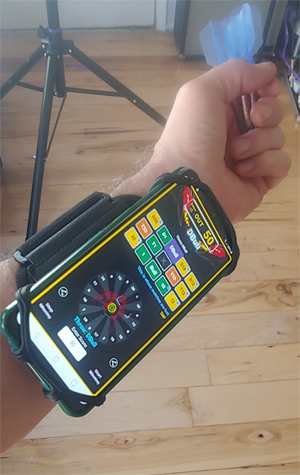
61 Checkout in Darts — T15, D8
The 61 checkout runs T15 → D8 — a two-dart finish that rewards clean execution on the opening dart before settling into a direct path to D8, one of the stronger finishing doubles on the board. At 61, the structure of the visit matters more than individual dart quality. Players who follow the route rather than improvising finish this score far more consistently than those who adjust mid-visit based on imperfect first darts.
Controlling the dart toward the 10 side on the opening throw from 61 is the miss management available here. A drift into 10 leaves 51 (11 → D20) — a manageable recovery position. The 2 side leaves 59, which creates a significantly harder continuation. The difference between those two outcomes is not small, and it is within the player's control to influence which one is more likely by building a slight directional preference into the throw preparation rather than aiming straight and hoping the miss falls the right way.
The sequence on 61 needs to be treated as two separate committed throws rather than as one connected action. Each dart in T15 → D8 should receive its own approach and its own full commitment — T15 thrown to T15, and D8 thrown to D8. Players who think about the double during the opening dart are splitting their attention across the visit in a way that reliably degrades the quality of the throw that needs it most.
The visit on 61 should feel identical to the same route in practice — same pace, same process, same sequence. Any deviation from that is pressure expressing itself through behaviour. The players who finish 61 reliably in competition have stopped treating it as a pressure situation. For them, it is just the next throw in a sequence. The miss on 61 under pressure almost always lands in a predictable place — low and inside. That is a timing miss, not an aim miss. The correction is tempo, not target adjustment. Under pressure on 61, the temptation is to get the throw over with quickly. That urgency is pressure expressing itself through pace. Slow the pre-throw and the throw itself will regulate. The gap between practice performance and match performance on 61 is always a pressure gap. Closing it requires training the pressure response, not just the throw.
The strength of this route against match pressure is its lack of weak links. T15 scores aggressively, D8 closes reliably, and even imperfect darts in the middle still produce a workable position.
Route Comparison & Target Selection
Primary: T15 → D8
treble 15 (45), closing on double 8 — high-percentage close
Alternate: 1 → 20 → D20
single 1, single 20, closing on double 20 — high-percentage close — no triple required on opener
The primary (T15 → D8) is built for situations where the match demands performance: T15 scores aggressively, the route structure is efficient, and D8 closes the leg with the visit's full momentum intact. The alternate (1 → 20 → D20) is built for situations where the match position allows protection: 1 is a single that removes the triple requirement, reduces first-dart breakdown risk, and still arrives at D20 to close. Use the primary as the default. Use the alternate deliberately — it is a match-state tool, not a conservative fallback.
The key miss geometry: 10 leaves 51 (workable), 2 leaves 59 (harder). Bias toward 10.
Miss Geometry, Route Structure & When to Use the Alternate
The first dart targets treble 15, sitting between 10 and 2 on the board. From 61 a miss into 10 leaves 51 remaining and a miss into 2 leaves 59. The preferred drift direction is toward 10, which produces 51 — a more workable recovery position than the 2 side. Knowing which direction is the better miss before stepping to the oche is the margin that separates reactive play from controlled play. The throw setup — grip angle, release point, follow-through direction — can subtly favour the preferred side without disrupting throw rhythm. Over a long match, consistently landing on the better miss side rather than the worse one compounds into a meaningful positional advantage. Looking at how the route is built, two darts, direct finish: T15 → D8. From 61 the route asks for T15 to land correctly, then D8 to close the leg. The compactness of a two-dart finish is its defining quality — fast, readable, and immediately decisive. It is also what makes the opening dart carry the most weight of any dart in the visit. Arriving at D8 from a controlled, rhythm-based T15 produces a different kind of close than arriving at it from a nervous or guided first throw. The finish is the same; the confidence brought to it is not. Regarding the choice of route, the alternate route — 1 → 20 → D20 — is the match-state choice, and understanding when to use it is as important as knowing the primary. When a comfortable lead means protecting the leg outweighs the need to press, opening on 1 instead of T15 removes the triple requirement from the first dart entirely. The target area is larger, the miss cost lower, and the leg still closes on D20 through a path that does not demand a 6mm bed on the opening throw. The primary is the default for its scoring efficiency and route structure. The alternate is correct when the match situation — a commanding lead, a leg that is effectively won — justifies reducing first-dart precision in exchange for greater reliability through the close.
When and Why to Use This Route
Use this route as the default from this score — it combines aggressive scoring through T15 with one of the most reliable finishing doubles on the board at D8. There is no match situation where this route is the wrong choice. Whether the opponent is on a finish, comfortably behind, or within range, T15 applies pressure and D8 closes it cleanly.
This route works because it combines two structural strengths without compromise. T15 scores efficiently — it applies real pressure and creates the correct leave for the close — while D8 is one of the most forgiving finishing doubles on the board. Neither component is a weakness. Players who use this route benefit from aggressive scoring on the opening dart and a reliable, high-percentage close. Routes that sacrifice one for the other are weaker than this structure, which sacrifices nothing.
Why Players Miss This Finish
Two-dart checkouts on 61 are missed because of what happens between the first dart landing and the second one being thrown. When T15 lands in the bed, the player is immediately aware the close is one dart away. That awareness changes the approach to D8 — the grip tightens slightly, the tempo changes, and the dart that was going in practice drifts. The player who closes 61 reliably has learned to treat D8 as the same throw as T15: same tempo, same grip, no additional deliberation. The score changes. The throw does not.
The fix is specific: before stepping to the oche on 61, decide the full route, decide the preferred miss direction on T15, and commit to both before throwing the first dart. Players who make these decisions at the line rather than before it are making them while moving — which means they are made reactively rather than deliberately. A decision made before the approach is a decision that holds under pressure. A decision made mid-approach changes the throw.
Practice
Build the 61 checkout by treating T15 and D8 as a single connected action rather than two separate throws. In practice, run the sequence with a target: three completions before stopping, or a conversion rate across ten attempts. The target creates the same kind of pressure that a match creates — not identically, but closely enough that the throw under target conditions is more representative of the throw in a match than a throw made with no consequence.
Include recovery reps in every 61 practice session. When T15 drifts into 10, the leave is 51 — practise that score until it feels routine, because it is the most likely leave after an imperfect first dart. When T15 drifts into 2, the leave is 59 — that one deserves practice too, because a leave that has never been practised becomes a source of hesitation in a match. Building familiarity with both miss outcomes means the visit continues automatically rather than stalling after a drift on the opener.