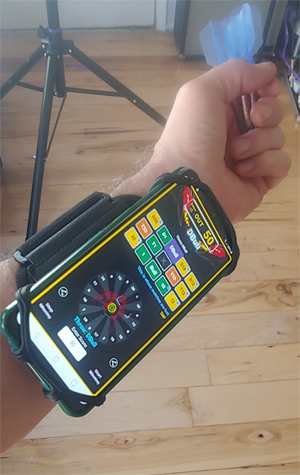
110 Checkout in Darts — T20, DBull
On 110, the challenge is not reaching the double — it is the controlled execution required to get there. The route — T20 → DBull — is the most efficient path from this score to DBull. What makes high-score finishes in 501 demanding is that the first dart carries the weight of the entire visit — a clean T20 sets up a controlled close, while a miss forces a decision about recovery before the route has even begun.
The preferred miss direction on T20 from 110 is toward 5. Landing there leaves 105 — a position that still carries a realistic path to the close. The 1 side leaves 109 and a harder problem. Players who pay attention to miss geometry on their primary scoring targets consistently produce better outcomes from imperfect darts, which is where most of the marginal gains in competitive 501 are actually found — not in perfect throws, which are the same for everyone, but in where the imperfect ones land.
Players who are reliable at finishing 110 in competition have usually identified and eliminated one specific failure pattern from their game: the tendency to respond to what just happened rather than commit to what comes next. If the first dart misses, the instinct is to adjust — to be more careful, to aim more precisely, to compensate. That instinct is the source of most dropped legs on 110. The route provides the continuation from any reasonable first-dart outcome. Trusting the route rather than overriding it mid-visit is the discipline that converts practice form into match results.
Match the walk, the stance, and the grip on 110 exactly to what they are in practice. Those three things being identical is the entire strategy for managing the rest. This is a critical part of darts checkout strategy and match play control — the ability to execute under pressure separates recreational players from competitive ones. On 110, the pressure is visible — the opponent knows a finish is on. The players who close it ignore that fact and focus entirely on the process. On 110, the only difference between practice and match play is the number of thoughts between stepping to the oche and releasing the dart. Fewer thoughts means a better result. Physical tension on 110 under pressure is involuntary. What is voluntary is recognising it before stepping forward and deliberately relaxing the grip before the throw begins.
Against an opponent who can win next visit, the bull route on 110 offers the fastest close available. That speed is worth the reduced recovery margin when the match situation demands urgency.
Route Comparison & Target Selection
Primary: T20 → DBull
treble 20 (60), closing on bull (50) — direct bull finish
Alternate: T20 → 10 → D20
treble 20 (60), single 10, closing on double 20 — high-percentage close
The primary route uses the bull to close — direct, fast, and binary. Hit it and the leg ends. Miss it and the recovery position is harder than a missed standard double would produce. The alternate (T20 → 10 → D20) routes to D20 instead, which splits cleanly and provides a workable recovery. Use the primary when urgency outweighs recovery margin. Use the alternate when the close quality matters more than the close speed. The match situation determines which of those is the priority.
Avoid 25 on this route. A miss into the outer bull removes the finish and means the leg must be rebuilt.
Miss Geometry, Route Structure & When to Use the Alternate
Treble 20 has the weakest miss geometry of any primary scoring target. Its neighbours — 5 and 1 — are the two lowest-value singles on the board, and from 110 a drift into either one costs significant route quality. A miss into 5 leaves 105; into 1 it leaves 109. The preferred miss direction on this score is toward 5, which produces 105 — a more workable position than the 1 side's 109. Even with that knowledge, the underlying geometry remains weak. Treble 19, flanked by 3 and 7, offers a structurally safer target when grouping is drifting: the miss cost on both sides is lower, the leaves are more often finishable, and the overall route from 110 remains more intact after an imperfect first dart. On the route structure itself, two darts, direct finish: T20 → DBull. From 110 the route asks for T20 to land correctly, then DBull to close the leg. The compactness of a two-dart finish is its defining quality — fast, readable, and immediately decisive. It is also what makes the opening dart carry the most weight of any dart in the visit. Arriving at DBull from a controlled, rhythm-based T20 produces a different kind of close than arriving at it from a nervous or guided first throw. The finish is the same; the confidence brought to it is not. On the question of the alternate, the alternate (T20 → 10 → D20) closes on D20 — a higher-percentage finishing double than the primary's DBull. When the priority is arriving at the most forgiving possible close, the alternate is the correct adjustment. The primary is the default for its overall route structure; the alternate offers a stronger finishing double at the cost of a different approach. In match conditions where landing the easiest possible final dart matters most — whether from fatigue, pressure, or a close score — the alternate's stronger close is the right trade.
When and Why to Use This Route
This route is correct when the opponent can win on their next visit and a direct finish is needed. The bull's value is its speed — it ends the leg without building toward a standard double. That speed is the reason to use it. When urgency is absent, the standard route to a reliable double is the better structure.
The strength of this route is its directness. Rather than working through a scoring setup and then building toward a standard double, the bull provides a single target that ends the leg immediately. The absence of intermediate darts means there is nothing between the player and the finish — hit the bull and the leg is over. That simplicity is the route's defining advantage, and it is why the bull route is correct when speed matters more than recovery options.
Why Players Miss This Finish
The bull as a finish on 110 is harder in matches than in practice for a specific reason: the match environment activates grip tension. When a player is aware the bull will end the leg, the hand closes fractionally tighter around the dart. That extra grip pressure changes the release point — the dart hangs in the fingers slightly longer than it should — and it drifts. The player's aim was correct. The release was not. Releasing grip tension deliberately before stepping to the oche is the single most effective adjustment available on bull finishes under match pressure.
The correction on a bull finish at 110 is grip pressure, not aim adjustment. Before stepping to the oche, consciously release some of the tension in the throwing hand. The grip does not need to be loose — it needs to be the same grip used for every other successful dart. If the grip is tighter than usual, the dart will release later than usual, and later release means lower and wider. Releasing the tension before the throw is the single most actionable adjustment available on bull finishes under match pressure.
Practice
The simplest effective practice format for 110 is a completion drill: attempt T20 → DBull repeatedly, require three consecutive successful completions before finishing the exercise, and restart the count every time a dart misses. This format produces more useful practice than fifty relaxed attempts because the final dart in each set carries real consequence. That consequence is what trains the composure that match finishes require — not just the accuracy.
Practise 105 and 109 explicitly as part of the 110 practice block. These are the scores left by the two miss directions from T20 — 105 via 5 and 109 via 1. A player who knows both continuations and has thrown them recently does not need to think when one of them appears in a match. The visit continues. That automaticity is what keeps legs alive after an imperfect first dart. Pair the full route practice with recovery reps so neither feels unfamiliar when the match requires it.