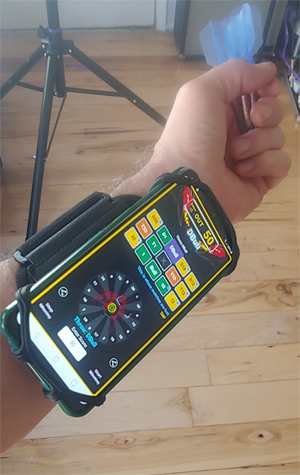
53 Checkout in Darts — 13, D20
Finishing 53 comes down to confidence and precision on D20. The route — 13 → D20 — creates the right position efficiently with a single setup dart at 13, and the close depends on committing to D20 without hesitation. At this score, hesitation is the most common cause of missed finishes in match play — not poor aim, not technical fault, but a pause in the delivery that changes the release point and drops the dart below the intended target.
Controlling the dart toward the 4 side on the opening throw from 53 is the miss management available here. A drift into 4 leaves 49 (9 → D20) — a manageable recovery position. The 6 side leaves 47, which creates a significantly harder continuation. The difference between those two outcomes is not small, and it is within the player's control to influence which one is more likely by building a slight directional preference into the throw preparation rather than aiming straight and hoping the miss falls the right way.
The sequence on 53 needs to be treated as two separate committed throws rather than as one connected action. Each dart in 13 → D20 should receive its own approach and its own full commitment — 13 thrown to 13, and D20 thrown to D20. Players who think about the double during the opening dart are splitting their attention across the visit in a way that reliably degrades the quality of the throw that needs it most.
The moment between stepping to the oche and beginning the throw is where pressure is managed. Use that moment deliberately — breathe, grip consistently, commit. Consistent finishing in darts depends on mental control as much as technique — and mental control, like technique, is trainable through structured practice. Finishing 53 mid-range requires staying in the routine. The players who drop this score are usually thinking about the result instead of the process. The mental side of finishing 53 is not separate from the technical side. They are the same challenge, solved by the same consistent routine. The dart responds to the mechanics of the throw. Keep those mechanics consistent and pressure becomes irrelevant to the outcome.
If the opponent is not on a finish, this route is ideal — it preserves control and ends on D20, one of the preferred closing doubles on the board.
Route Comparison & Target Selection
Primary: 13 → D20
single 13, closing on double 20 — high-percentage close
Alternate: 5 → 16 → D16
single 5, single 16, closing on double 16 — high-percentage close — no triple required on opener
Two distinct approaches are available from 53. The primary (13 → D20) takes the aggressive line — 13 on the opening dart applies real scoring pressure and leads into D20 as the close. The alternate (5 → 16 → D16) opens on 5, a wider target that removes the need for triple precision. The leg still closes on D16. The distinction is match-contextual: the primary is for tight legs and pressing situations; the alternate is for comfortable leads where protecting the route is more important than maximising first-dart scoring. Neither route is a fallback — both are deliberate choices for defined situations.
The anti-target on 13 is 6. A miss there leaves 47 — the preferred miss is into 4 for 49.
Miss Geometry, Route Structure & When to Use the Alternate
The route from 53 starts on 13, a single that asks less of the first throw than a triple would. The wider target area means slight misses are absorbed more cleanly, and the leave it creates is the correct position for the rest of the route. The broader single area means drift registers a score rather than a miss. The structure from 53 is deliberate — 13 is the right first dart, and the commitment it deserves is identical to any other dart in the visit. In terms of the dart count and sequence, the finish from 53 is direct: 13 then D20. No intermediate setup dart is needed or available. Two-dart routes are compact, readable, and unforgiving — the first dart either creates the close or it does not, and the second dart either closes the leg or it does not. The efficiency of this structure is why two-dart finishes are the most practised in competitive 501, and why precision on the opening dart is the single most important execution variable on any score that breaks into one. On the alternate route decision, two routes are available from 53. The primary (13 → D20) takes the aggressive line through 13, applying maximum pressure and reaching the close most efficiently when the first dart lands correctly. The alternate (5 → 16 → D16) starts on 5 — a larger target, lower miss cost — and closes on D16 through a route that does not demand triple precision on the first throw. A big lead justifies the alternate: the leg is more valuable protected than pressed. A tight leg demands the primary: scoring speed and route efficiency matter more than first-dart comfort.
When and Why to Use This Route
Apply this route in standard match situations and under pressure. The controlled opening at 13 removes the risk of a forced first dart, and D20 provides a clean, high-percentage close. This is the route to use when closing the leg cleanly matters more than scoring aggressively.
This route is effective because it treats close quality as the primary objective. D20 is a strong finishing double that rewards clean approach play and is forgiving on a slight miss. Getting there through 13 rather than a more aggressive opener means the player arrives at the close with better rhythm and less accumulated tension. That rhythm is what makes D20 reliable in match conditions.
Why Players Miss This Finish
Players miss 53 through route abandonment. The original plan — 13 → D20 — is correct. A slightly off first dart changes the leave in a small way, and the player decides mid-visit to improvise rather than read the new score and continue with the adjusted route. That improvisation introduces a dart thrown to a target that was chosen quickly rather than correctly. The miss almost always comes from the improvised dart, not the original miss. Players who read their actual leave after every dart and continue with the best available path from there close 53 significantly more often than those who try to recover the original route after a drift.
The fix is specific: before stepping to the oche on 53, decide the full route, decide the preferred miss direction on 13, and commit to both before throwing the first dart. Players who make these decisions at the line rather than before it are making them while moving — which means they are made reactively rather than deliberately. A decision made before the approach is a decision that holds under pressure. A decision made mid-approach changes the throw.
Practice
Practise the 53 checkout by running 13 → D20 as a complete two-dart sequence rather than throwing each dart separately. The transition between 13 and D20 is where two-dart routes most often break down — a good opener creates expectation about the close, and that expectation sometimes changes the throw on D20 in exactly the wrong direction. Run the sequence clean five times. If the break is consistently on the second dart, practise D20 in isolation for a set, then reintegrate it into the full route.
Include recovery reps in every 53 practice session. When 13 drifts into 6, the leave is 47 — practise that score until it feels routine, because it is the most likely leave after an imperfect first dart. When 13 drifts into 4, the leave is 49 — that one deserves practice too, because a leave that has never been practised becomes a source of hesitation in a match. Building familiarity with both miss outcomes means the visit continues automatically rather than stalling after a drift on the opener.