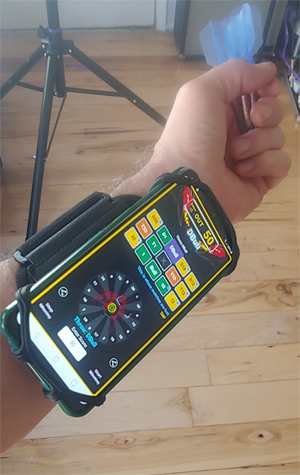
25 Checkout in Darts — 9, D8
The 25 checkout is where the leg gets closed or dropped through execution alone. The route is 9 → D8. 9 creates the leave and D8 finishes it. Players who are most reliable at finishing scores like 25 in match conditions are those who have found a way to treat close-range finishes as routine rather than special. The double is the same size in a match as it is in practice. The throw is identical. The difference is internal — and it is manageable through deliberate repetition under pressure conditions.
The miss geometry on the opening dart favours the 14 side. A drift from 9 in that direction leaves 11 — 3 → D4, which preserves a working route. The 12 side produces 13, a harder position to continue from. That asymmetry is useful information: the pre-throw setup can subtly bias the release toward the 14 side without altering the fundamental mechanics of the throw. Knowing which direction is the preferred miss before stepping to the oche removes a decision that would otherwise be made reactively — and reactive decisions under pressure rarely favour the better outcome.
The decision about which route to use from 25 should be made before stepping to the oche — not at it, and not during the visit. Arriving at the line already having chosen 9 → D8 removes an entire category of thought from the throw. Players who are still weighing options as they step forward introduce a kind of cognitive load that does not appear in practice but is consistently present in match conditions. Deciding the route in advance and committing to it completely is the structural version of pressure management — it reduces the number of decisions that need to be made while throwing.
Players who miss the close on 25 under pressure almost never miss because the double is genuinely difficult. They miss because the throw changes — slower, tighter, more deliberate — and the dart responds accordingly. Good players do not speed up under pressure — they simplify. Fewer thoughts, same tempo, full commitment on the target. The most reliable predictor of a missed checkout on 25 under pressure is a grip that tightened at some point between the previous throw and the current one. Keep breathing steady before stepping to the oche — shallow breath before a throw is one of the most consistent physical signs of grip tension building. Handling pressure is one of the core skills in competitive darts finishing, and deliberate practice creates a measurable and lasting advantage here.
Against pressure, the strength here is the double quality. D8 is exactly the right target to be arriving at when urgency increases and execution must still be clean.
Route Comparison & Target Selection
Primary: 9 → D8
single 9, closing on double 8 — high-percentage close
Alternate: 5 → D10
single 5, closing on double 10 — solid close — no triple required on opener
The distinction between these routes comes down to when aggression is appropriate. The primary (9 → D8) presses through 9 — the triple maximises scoring and the route closes on D8. That aggression is correct when the leg is competitive. The alternate (5 → D10) opens on 5 instead, removing the triple requirement and arriving at D10 through a route that is harder to break down on the opening dart. That control is correct when a lead makes protecting the leg more valuable than pressing it. Neither is universally better. Both are correct in their specific context.
On 9, avoid drifting into 12 — it leaves 13, which is a significantly weaker position than the 14 side which leaves 11.
Miss Geometry, Route Structure & When to Use the Alternate
The route from 25 starts on 9, a single that asks less of the first throw than a triple would. The wider target area means slight misses are absorbed more cleanly, and the leave it creates is the correct position for the rest of the route. The broader single area means drift registers a score rather than a miss. The structure from 25 is deliberate — 9 is the right first dart, and the commitment it deserves is identical to any other dart in the visit. In terms of the dart count and sequence, two darts close the leg from 25: 9 into D8. The route carries no setup phase, which concentrates the entire execution requirement on the opening dart. Landing 9 cleanly creates a one-dart close; missing it creates an immediate recovery problem with no middle dart to absorb the error. Two-dart routes reward decisive, committed play and punish hesitation or steering on the first throw. The correct approach is to treat 9 as a fully committed throw to a specific target — not a careful, guided approach — and let D8 follow from a controlled position. On the alternate route decision, match position determines which route to throw from 25. The primary (9 → D8) opens on 9 for maximum scoring efficiency and applies the pressure a close match demands. The alternate (5 → D10) opens on 5 — a wider target with a lower miss cost — and still closes on D10 through a less demanding path. The decision belongs in the pre-visit setup: at a comfortable lead, choose the alternate and commit to it; in a tight leg, choose the primary and commit to that. Making the decision at the oche rather than before it is where the alternate route gets misused — selecting it reactively rather than deliberately.
When and Why to Use This Route
Apply this route when the close matters most. D8 is the strongest double this route can offer and the path to it through 9 is controlled enough to reproduce across visits, even when pressure builds.
The strength of this route is that it makes the close as reliable as possible by protecting the approach. A triple-first route asks for precise execution on the opening dart before the close can even begin. This route opens on 9, which is more forgiving on a slight miss, and uses the resulting control to arrive at D8 from a clean, unhurried position. D8 is one of the best doubles in 501. This route gives it the best chance to perform.
Why Players Miss This Finish
The 25 checkout is dropped when players make the visit conditional on the first dart landing perfectly. If 9 goes where it should, the route continues. If it drifts, the player pauses, adjusts, recalculates — and introduces tension into a visit that was still perfectly recoverable. Most misses on 9 from 25 still leave a clean continuation. The mistake is treating a slight drift as a reason to change the plan rather than a reason to read the new score and commit to the next dart.
Improving on 25 in competition comes from accepting that the throw will not always be perfect and building an automatic response to imperfection. The players who drop this score are usually players who need everything to go right. The players who close it are the ones who have practised enough variants of the route — clean first dart, slightly off first dart, both miss directions — that the visit runs on autopilot regardless of the opening outcome.
Practice
The simplest effective practice format for 25 is a completion drill: attempt 9 → D8 repeatedly, require three consecutive successful completions before finishing the exercise, and restart the count every time a dart misses. This format produces more useful practice than fifty relaxed attempts because the final dart in each set carries real consequence. That consequence is what trains the composure that match finishes require — not just the accuracy.
Add consequence to the end of every 25 practice block. After completing the route a set number of times cleanly, throw 9 deliberately off-line and practise continuing from 11 and 13 without resetting. This forces the continuation habit — the automatic response to a miss on the opener that keeps the visit running rather than stalling. Players who have practised their recovery positions finish more legs from imperfect visits than those who only ever practise the clean route.