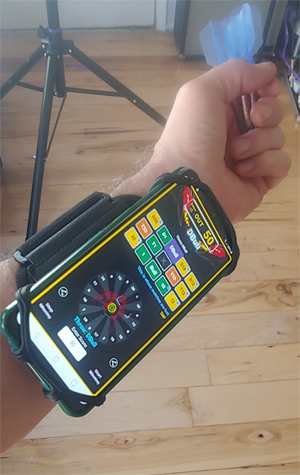
129 Checkout in Darts — T19, T16, D12
At 129, the leg is decided by the quality of the opening throw more than any other single factor. The route — T19 → T16 → D12 — is built to convert that first dart into a clear path to D12. Players who finish 129 reliably treat the opening triple as the highest-consequence dart in the visit, not the double — because the double becomes straightforward when the approach is controlled, and becomes genuinely hard when it is not.
Miss direction on the opening dart matters specifically on 129 because the preferred and non-preferred outcomes diverge significantly. The 3 side leaves 126. The 7 side leaves 122. That difference — between a strong recovery position and a weak one — is the reason miss geometry is taught as an active skill rather than a passive observation. Applying it means building a slight lean toward 3 into the throw preparation, not changing the aim, but shaping the release so that a drift lands where you have already decided it should.
In match conditions, the biggest risk on 129 is not a technically poor dart — it is a dart thrown to the result rather than to the target. The player who is thinking about what the score will be after the throw, or whether the close is going to be available, or what the opponent is on, has already moved away from the execution mindset that finishes legs. The route T19 → T16 → D12 is decided. The target is decided. The only remaining decision is to commit fully to T19 and let the visit run according to the structure.
At 129, players often chase perfect darts instead of staying within the structure — which is exactly how a reachable finish turns into a dropped leg. The players who handle pressure best on 129 have rehearsed the discomfort often enough that it no longer disrupts the throw. Tension changes the release point. A tighter grip means the dart leaves the hand later and lands lower. That is the miss that pressure creates, and it is preventable. Slow the approach down, not the throw. Walking to the oche deliberately creates time to settle. The throw itself should be exactly as fast as it always is. The gap between practice performance and match performance on 129 is always a pressure gap. Closing it requires training the pressure response, not just the throw.
Triple start into an elite double is the strongest structure under pressure. Commit to T19 and trust D12 — this route holds up when it matters.
Route Comparison & Target Selection
Primary: T19 → T16 → D12
treble 19 (57), treble 16 (48), closing on double 12 — high-percentage close
Alternate: T19 → T20 → D6
treble 19 (57), treble 20 (60), closing on double 6 — demanding close
The close is where these routes diverge. The primary (T19 → T16 → D12) arrives at D12, a higher-percentage double. The alternate (T19 → T20 → D6) arrives at D6, which is less forgiving on the final dart. The miss geometry on T19 is workable on both sides — 126 and 122 are both recoverable positions. For most match situations, the primary's stronger close makes it the better default. Consider the alternate only when the primary's specific approach is not landing well — the trade is a more familiar line for a weaker finishing double.
The key miss geometry: 3 leaves 126 (workable), 7 leaves 122 (harder). Bias toward 3.
Miss Geometry, Route Structure & When to Use the Alternate
Treble 19 opens this route because the score structure makes it the geometrically and mathematically correct first dart. Its neighbours (3 and 7) are both higher-value than the 5 and 1 that flank treble 20, meaning misses from 129 into either side carry a lower recovery cost. A drift into 3 leaves 126; into 7 leaves 122. The stronger miss geometry combined with the route it builds toward the close makes treble 19 the right call here — not a concession to a poor grouping on 20, but the primary choice from first principles. For the structure from here, from 129 the route needs three darts: T19 → T16 → D12. T19 is the scoring dart, T16 is the positioning dart, and D12 is the close. That structure exists because the score does not allow a shorter path. The positioning dart (T16) is particularly critical: arriving at D12 in control of the close requires that T16 lands exactly where the route requires, not approximately there. Understanding why each dart appears in the sequence — rather than treating the route as a single action — is part of executing three-dart finishes reliably in competitive play. As for the alternate route, between the two options, the primary closes on the stronger double (D12 versus the alternate's D6). That edge accumulates in match play — arriving at a higher-percentage close through a sound route structure is the combination the primary provides. The alternate (T19 → T20 → D6) is the contingency when the primary's approach breaks down on a given visit, not the default.
When and Why to Use This Route
This is the correct route regardless of the score in the match. T19 puts pressure on the opponent while D12 gives the best possible finish. A player who uses this route consistently from this score will close more legs than one who looks for alternatives based on match state.
This approach is effective because the two components reinforce each other rather than trading off against one another. T19 creates scoring momentum and leaves the finish within reach. D12 converts it without demanding perfect execution at the close. The player who uses this route aggressively and commits to both darts will close more legs from this score than any alternative route provides.
Why Players Miss This Finish
The most common pattern in a missed 129 checkout: T19 lands cleanly, T16 is rushed or slightly off, D12 is either unavailable or approached under recovered tension. The sequence breaks down in the middle, not at the close. Players who are aware of this pattern and deliberately slow their approach to T16 — giving it the same deliberate attention as the opening dart — close 129 significantly more often. The route is three committed throws, not a strong opener followed by two consequences.
The fix is specific: before stepping to the oche on 129, decide the full route, decide the preferred miss direction on T19, and commit to both before throwing the first dart. Players who make these decisions at the line rather than before it are making them while moving — which means they are made reactively rather than deliberately. A decision made before the approach is a decision that holds under pressure. A decision made mid-approach changes the throw.
Practice
Run T19 → T16 → D12 in sets of five attempts and track how many convert cleanly in two visits or fewer. That number is more informative than raw completion rate because it reflects whether the route is working or whether legs are being closed through recovery. A high raw completion rate with low two-visit conversion means the route is closing eventually but not efficiently — the visits are running long, which means first or second dart quality needs work. A low completion rate with decent two-visit conversion means the close is the problem. The metric reveals where to focus practice.
Include recovery reps in every 129 practice session. When T19 drifts into 7, the leave is 122 — practise that score until it feels routine, because it is the most likely leave after an imperfect first dart. When T19 drifts into 3, the leave is 126 — that one deserves practice too, because a leave that has never been practised becomes a source of hesitation in a match. Building familiarity with both miss outcomes means the visit continues automatically rather than stalling after a drift on the opener.