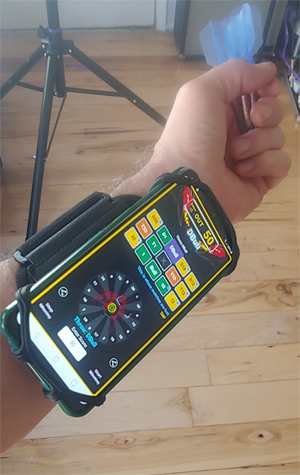
156 Checkout in Darts — T20, T20, D18
Finishing 156 requires aggressive scoring paired with structured execution — the first dart must do real work while still leaving the visit on track for a clean close. The route T20 → T20 → D18 handles that balance by opening on T20, which scores efficiently and creates the exact leave needed to reach D18 cleanly.
Controlling the dart toward the 5 side on the opening throw from 156 is the miss management available here. A drift into 5 leaves 151 — a manageable recovery position. The 1 side leaves 155, which creates a significantly harder continuation. The difference between those two outcomes is not small, and it is within the player's control to influence which one is more likely by building a slight directional preference into the throw preparation rather than aiming straight and hoping the miss falls the right way.
The sequence on 156 needs to be treated as three separate committed throws rather than as one connected action. Each dart in T20 → T20 → D18 should receive its own approach and its own full commitment — T20 thrown to T20, T20 thrown to T20, and D18 thrown to D18. Players who think about the double during the setup darts are splitting their attention across the visit in a way that reliably degrades the quality of the throw that needs it most.
Control on the first dart at 156 is more valuable than any other single factor. The rest of the visit stays structured when the opening dart lands clean. There is no special technique for throwing under pressure. The technique is the same. What changes is the willingness to trust it when the result matters. When the arm tightens, accuracy drops even when the line to the target is correct. The throw fails because the timing changes, not because the aim is wrong. Match your practice rhythm exactly — the same tempo, the same grip, the same release point. That consistency is the entire strategy for pressure finishing. In competitive darts, the checkout is where matches are decided. The ability to execute under pressure on scores like 156 is the defining skill at the highest level.
Against a player who can win next visit, the opening dart on 156 is where the leg is decided. Commit to T20 without reservation and let the route do its work.
Route Comparison & Target Selection
Primary: T20 → T20 → D18
treble 20 (60), treble 20 (60), closing on double 18 — solid close
The miss to avoid on T20 is 1 leaving 155. The good side — 5 — leaves 151. Know this before the throw.
Miss Geometry, Route Structure & When to Use the Alternate
The treble 20 bed sits between two of the cheapest segments on the board: 5 and 1. On 156 a miss into 5 leaves 151 and a miss into 1 leaves 155. Neither leave is catastrophic, but the neighbour geometry of treble 20 is the weakest of any high-value target, which is why it demands the most reliable grouping to be worth the commitment. When darts are consistently landing below the bed rather than inside it, the geometry of treble 19 makes it the stronger structural target. Its neighbours — 3 and 7 — score more than the 1 and 5 flanking the 20, meaning drift costs less and leaves more workable routes. That neighbour difference is not trivial. Over a leg it compounds, which is why the switch to 19 is a positional decision rather than a mechanical one. Beyond the opening dart geometry, the route from 156 runs T20, T20, D18. Two consecutive throws at the same target before the close place grouping consistency at the centre of the execution requirement. Where routes with different setup darts allow for slight adjustments between throws, this one rewards the player who treats both T20 darts as a single committed decision repeated rather than two separate aim events. That approach — throw once, repeat the throw — is what produces tight, predictable grouping on back-to-back visits to the same segment under match conditions.
When and Why to Use This Route
Use this route as the primary approach from this score. D18 is achievable from a controlled visit and responds to a committed throw even when the approach is not perfect. The route does not require ideal conditions to work — that reliability is the point.
The route works by combining a practical opener with a dependable close. T20 is not the most aggressive start available but it is reliable and produces a workable leave. D18 is not the easiest close on the board but it is a solid double that responds to a committed throw. The combination is the most practical available structure from this score — not flashy, but consistently effective.
Why Players Miss This Finish
The 156 checkout is dropped most often when the opening dart goes well and the player relaxes prematurely. T20 lands cleanly, the finish is visible, and the body releases tension before the visit is complete. That premature relaxation reduces the commitment on T20 — the dart is thrown with less precision because the player has already mentally prepared to throw D18. The route requires three darts with the same level of commitment, not two hard throws and one formality. The second dart is where this finish is most often lost.
The practical correction for consistent misses on 156 is to identify which dart in the route is the problem dart — the one that is most often not where it needs to be — and practise that dart specifically under match-like conditions. For most players on 156, the problem dart is not the close. It is either the opener or the middle dart. Practising the close when the problem is earlier in the route is one of the most common and least productive practice habits in club-level 501.
Practice
The most effective practice structure for the 156 checkout is to run T20 → T20 → D18 as a complete sequence and track the breakdown point. Where does the visit most often fail — on T20, on T20, or approaching D18? Once the breakdown point is identified, give that dart specific attention: practise it in isolation to diagnose the problem, then reintegrate it into the full sequence. Most players practise the dart they are most comfortable with. The fastest improvement comes from practising the one that is failing.
Practise 151 and 155 explicitly as part of the 156 practice block. These are the scores left by the two miss directions from T20 — 151 via 5 and 155 via 1. A player who knows both continuations and has thrown them recently does not need to think when one of them appears in a match. The visit continues. That automaticity is what keeps legs alive after an imperfect first dart. Pair the full route practice with recovery reps so neither feels unfamiliar when the match requires it.