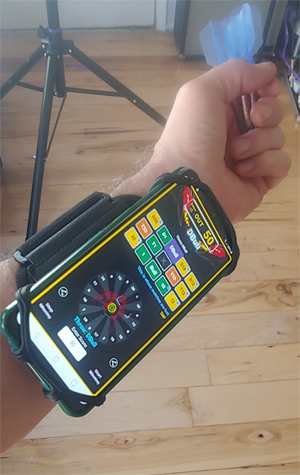
109 Checkout in Darts — T20, 9, D20
The 109 checkout uses a three-dart route through T20, 9 into D20. At this score, controlling the first dart is the central challenge — everything else in the route depends on where T20 lands. A clean execution through T20 → 9 → D20 leads directly into D20, one of the strongest finishing doubles on the board and a consistent closer under match pressure.
The miss geometry on the opening dart favours the 5 side. A drift from T20 in that direction leaves 104 — T19 → 15 → D16, which preserves a working route. The 1 side produces 108, a harder position to continue from. That asymmetry is useful information: the pre-throw setup can subtly bias the release toward the 5 side without altering the fundamental mechanics of the throw. Knowing which direction is the preferred miss before stepping to the oche removes a decision that would otherwise be made reactively — and reactive decisions under pressure rarely favour the better outcome.
The decision about which route to use from 109 should be made before stepping to the oche — not at it, and not during the visit. Arriving at the line already having chosen T20 → 9 → D20 removes an entire category of thought from the throw. Players who are still weighing options as they step forward introduce a kind of cognitive load that does not appear in practice but is consistently present in match conditions. Deciding the route in advance and committing to it completely is the structural version of pressure management — it reduces the number of decisions that need to be made while throwing.
Good players do not speed up under pressure — they simplify. Fewer thoughts, same tempo, full commitment on the target. Competitive players learn to separate the feeling of pressure from the mechanics of the throw. The feeling is real; it does not have to affect the arm. One breath before T20 from 109 — not a ritual, not a superstition, but a mechanical reset that gives the arm a chance to release without tension already built into the grip. Players who finish 109 consistently in competition are not naturally calmer than those who miss it. They have simply rehearsed the response to pressure enough that it no longer interferes with the mechanics. Finishing 109 from the high range is a three-dart commitment problem. Each dart needs to be thrown without reference to the result — the route handles the result.
Against an opponent on a finish, the worst thing on 109 is a passive, careful approach. This route — T20 → 9 → D20 — asks for commitment at every dart. That commitment is what the match situation demands.
Route Comparison & Target Selection
Primary: T20 → 9 → D20
treble 20 (60), single 9, closing on double 20 — high-percentage close
Alternate: T19 → 12 → D20
treble 19 (57), single 12, closing on double 20 — high-percentage close
The primary (T20 → 9 → D20) and alternate (T19 → 12 → D20) are structurally comparable routes from 109 — similar approaches, similar close quality. The miss geometry on T20 is asymmetric — the 5 side leaves 104 and the 1 side leaves 108, so the preferred drift direction is toward 5. Use the primary as the default. Switch to the alternate when the primary's opening is not grouping correctly on a given visit. The comparable close means the switch does not trade close reliability for a different approach — it exchanges one route for another of equal standing.
Avoid 1 on this visit. It leaves 108 — the weaker of the two available miss directions. Better miss is 5 for 104.
Miss Geometry, Route Structure & When to Use the Alternate
The geometry around treble 20 is the most punishing on the board for missed triples. The 5 and the 1 sit either side of it — neither useful as a recovery segment from 109. A miss left into 5 leaves 104; a miss right into 1 leaves 108. The route opens on treble 20 because the scoring efficiency justifies it when the darts are landing in the bed. When they are not — when grouping drifts low consistently — switching to treble 19 corrects the geometry. The 3 and 7 that flank the 19 score more than the 5 and 1, and more often leave a position from which the leg can still be closed cleanly. That structural upgrade is the reason the switch is taught as a deliberate skill, not a fallback. Making the decision before stepping to the oche, and executing it with full commitment, is the competitive standard. As for the structure of the route, from 109 the route needs three darts: T20 → 9 → D20. T20 is the scoring dart, 9 is the positioning dart, and D20 is the close. That structure exists because the score does not allow a shorter path. The positioning dart (9) is particularly critical: arriving at D20 in control of the close requires that 9 lands exactly where the route requires, not approximately there. Understanding why each dart appears in the sequence — rather than treating the route as a single action — is part of executing three-dart finishes reliably in competitive play. When it comes to the alternate, when the primary route is not working on a particular visit, the alternate (T19 → 12 → D20) provides a different structural approach to the close. The path through T19 to D20 is comparable in quality to the primary's line, making it a genuine alternative rather than a fallback. Use the primary as the default from 109 and switch to the alternate when the opening dart or sequence on the primary visit is not producing the grouping the route requires.
When and Why to Use This Route
Apply this route in any match situation. The combination of T20 for scoring and D20 as the close is designed for exactly the conditions that competitive legs create. This is the strongest available route from this score — use it without reservation.
The strength of this route is that it does not ask the player to choose between power and reliability. T20 provides the scoring efficiency needed to keep the visit aggressive. D20 provides the close quality needed to convert. The combination makes this the strongest available route from this score — and the reason it holds up under match pressure better than alternatives that lean too far in either direction.
Why Players Miss This Finish
Players miss the 109 checkout by losing control of the visit on the second dart, not the first. T20 lands well and the position looks good — then, instead of committing fully to 9, the player is already thinking about D20. The second dart becomes distracted: aimed partly at 9 and partly at the result it will produce. That distraction costs accuracy. The dart lands somewhere other than intended, and the close on D20 is either harder than it should be or no longer available. Players who drop 109 regularly from a clean T20 are almost always losing the leg on dart two, not dart three.
Players who close 109 most reliably have solved the same problem: they have made the response to an imperfect dart automatic. When T20 lands slightly off, the right response is to read the new score immediately and throw the best available continuation without hesitation. That response is not instinctive — it is trained. Practising the recovery from the two most likely miss positions on T20 is the most direct way to reduce the number of legs dropped from a recoverable position on 109.
Practice
Practise the 109 checkout as a complete sequence — T20 → 9 → D20 — rather than drilling each dart in isolation. The rhythm between darts is as important as the accuracy of each individual throw. Players who practise T20 separately, then 9 separately, then D20 separately, and then combine them in a match often find the transition between darts is the problem, not the darts themselves. Run the full route in sets: three successful completions before stopping, or a conversion rate target like two clean legs in five attempts.
Recovery practice is not supplementary to 109 training — it is essential to it. The two most likely recovery positions from a miss on T20 are 104 (via 5) and 108 (via 1). Practising both of these scores alongside the full 109 route produces a player who can continue the visit without recalculation after an imperfect first dart. That continuation speed — the automatic response to a slight drift — is one of the most valuable and least-practised skills in club-level 501.