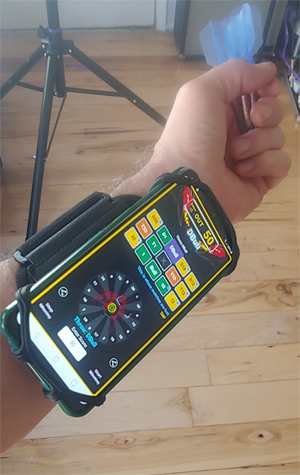
134 Checkout in Darts — T20, T14, D16
Finishing 134 in darts is a test of the whole visit — not just the close. The route through T20 → T14 → D16 demands that the opening dart at T20 is executed with the same commitment applied to the final dart, because from 134 the finish only becomes available after the first throw has created the right position. The route closes on D16, a high-percentage double that rewards clean approach play and is one of the most reliable closes in the game.
The preferred miss direction on T20 from 134 is toward 5. Landing there leaves 129 — a position that still carries a realistic path to the close. The 1 side leaves 133 and a harder problem. Players who pay attention to miss geometry on their primary scoring targets consistently produce better outcomes from imperfect darts, which is where most of the marginal gains in competitive 501 are actually found — not in perfect throws, which are the same for everyone, but in where the imperfect ones land.
Players who are reliable at finishing 134 in competition have usually identified and eliminated one specific failure pattern from their game: the tendency to respond to what just happened rather than commit to what comes next. If the first dart misses, the instinct is to adjust — to be more careful, to aim more precisely, to compensate. That instinct is the source of most dropped legs on 134. The route provides the continuation from any reasonable first-dart outcome. Trusting the route rather than overriding it mid-visit is the discipline that converts practice form into match results.
The pressure side of darts is not separate from the technical side. They are the same challenge. A well-rehearsed routine handles both simultaneously. At 134, the temptation is to rush and take the leg before the opponent responds. That urgency is the enemy of clean execution. Stay within the rhythm. Closing 134 under match pressure is fundamentally a repetition test — can the player reproduce the same throw that works in practice when the result is immediate? Tension before a pressure throw is normal. Acting on that tension by gripping tighter or slowing the release is the mistake. On 134, the window between the previous dart landing and this one leaving the hand is where composure is either maintained or lost. Own that window.
Against pressure, T20 and D16 are exactly what is needed — aggressive scoring and a reliable close. The route structure does not need adjustment for match context.
Route Comparison & Target Selection
Primary: T20 → T14 → D16
treble 20 (60), treble 14 (42), closing on double 16 — high-percentage close
Alternate: T20 → T18 → D10
treble 20 (60), treble 18 (54), closing on double 10 — solid close
Both routes open similarly, but the closes differ. The primary (T20 → T14 → D16) finishes on D16 — a higher-percentage double than the alternate's D10. That closing quality is a meaningful advantage in match conditions: a more forgiving final dart means more legs closed from otherwise equivalent visits. The miss geometry on T20 is asymmetric — the 5 side leaves 129 and the 1 side leaves 133, so the preferred drift direction is toward 5. The primary is the preferred default for this reason. Use the alternate (T20 → T18 → D10) when the approach through T20 produces better grouping on a specific visit, but expect to lose some close reliability in exchange.
Bias the throw away from 1 on 134. That miss leaves 133 vs the more manageable 129 from 5.
Miss Geometry, Route Structure & When to Use the Alternate
No high-value triple has worse neighbours than treble 20. The 5 sits to its left and the 1 to its right — the two lowest singles on the board. From 134, drifting into 5 produces 129 remaining and drifting into 1 produces 133. The primary route opens here because the score structure demands it, but the miss geometry should inform how you approach the throw. A slight drift in either direction from 134 lands in a segment that scores between three and five times less than the treble itself. Treble 19, by contrast, is flanked by 3 and 7 — both higher-value, both more often leaving a route that can still close cleanly. The drift trigger for switching to 19 exists precisely because of this asymmetry: when grouping moves consistently below the treble 20 bed, the geometry of 19 becomes structurally correct regardless of its lower maximum value. On the question of how the route runs, three darts are required here because 134 resists any clean two-dart path. The sequence runs T20 to open, T14 to position, and D16 to close — each dart serving a specific function in the structure. The risk that the three-dart sequence introduces is rushing: players who hit T20 cleanly sometimes accelerate through T14 and arrive at D16 from a weaker position than necessary. Slowing the decision-making between darts — giving each throw its own committed setup before the release — is what keeps three-dart routes running cleanly under pressure. As for when to use the alternate, the primary route's close on D16 is stronger than the alternate's finish on D10. That closing quality matters in match conditions: a more forgiving final double is a more reliable close under pressure. The alternate (T20 → T18 → D10) provides a different approach to a similar finish, and is there when the primary's line through T20 is not producing clean results.
When and Why to Use This Route
Use this route as the standard approach from this score. Scoring hard through T20 and finishing on D16 is the combination that wins the most legs — not just in comfortable situations, but especially in tight ones where both components need to deliver simultaneously.
This is an aggressive route that does not sacrifice reliability. T20 scores hard and applies pressure. D16 closes cleanly and forgives slight misses on the final dart. The combination is what makes this route correct as the default from this score — it does not require ideal conditions to work, and it does not need the player to choose between being aggressive and being controlled.
Why Players Miss This Finish
Players miss the 134 checkout by losing control of the visit on the second dart, not the first. T20 lands well and the position looks good — then, instead of committing fully to T14, the player is already thinking about D16. The second dart becomes distracted: aimed partly at T14 and partly at the result it will produce. That distraction costs accuracy. The dart lands somewhere other than intended, and the close on D16 is either harder than it should be or no longer available. Players who drop 134 regularly from a clean T20 are almost always losing the leg on dart two, not dart three.
Players who close 134 most reliably have solved the same problem: they have made the response to an imperfect dart automatic. When T20 lands slightly off, the right response is to read the new score immediately and throw the best available continuation without hesitation. That response is not instinctive — it is trained. Practising the recovery from the two most likely miss positions on T20 is the most direct way to reduce the number of legs dropped from a recoverable position on 134.
Practice
Practise the 134 checkout as a complete sequence — T20 → T14 → D16 — rather than drilling each dart in isolation. The rhythm between darts is as important as the accuracy of each individual throw. Players who practise T20 separately, then T14 separately, then D16 separately, and then combine them in a match often find the transition between darts is the problem, not the darts themselves. Run the full route in sets: three successful completions before stopping, or a conversion rate target like two clean legs in five attempts.
Recovery practice is not supplementary to 134 training — it is essential to it. The two most likely recovery positions from a miss on T20 are 129 (via 5) and 133 (via 1). Practising both of these scores alongside the full 134 route produces a player who can continue the visit without recalculation after an imperfect first dart. That continuation speed — the automatic response to a slight drift — is one of the most valuable and least-practised skills in club-level 501.