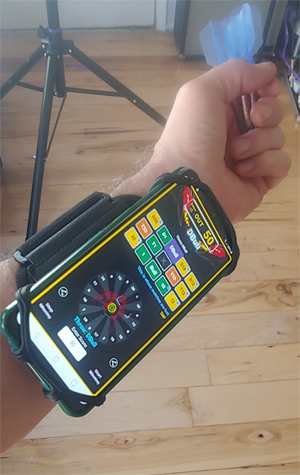
11 Checkout in Darts — 3, D4
Finishing 11 comes down to confidence and precision on D4. The route — 3 → D4 — creates the right position efficiently with a single setup dart at 3, and the close depends on committing to D4 without hesitation. At this score, hesitation is the most common cause of missed finishes in match play — not poor aim, not technical fault, but a pause in the delivery that changes the release point and drops the dart below the intended target.
From 11, the first dart at 3 has neutral miss geometry — both neighbours produce equivalent outcomes. A fat miss into the single 3 leaves 8 (D4), which is the best available miss outcome. Side misses into 17 or 19 are less forgiving. Without a preferred drift direction to target, the focus on 3 is centre-bed accuracy rather than directional bias.
What separates consistent finishers on 11 from inconsistent ones is rarely the route they choose. It is the quality of the decision-making that precedes each throw. Taking an extra moment before stepping to the oche to confirm 3 → D4 as the right route, confirm 3 as the right first target, and confirm full commitment to the execution removes the reactive thinking that pressure introduces. The throw itself is already there — what gets disrupted under match conditions is the clarity of intent before the throw begins.
On 11, pressure is visible — both players know a finish is on. The ones who close it treat it as just another dart in the leg. The throw fails under pressure when timing changes — not when aim changes. That distinction matters because it points directly to the fix. The routine before the throw matters as much as the throw itself. A consistent pre-throw process delivers a consistent throw regardless of what is riding on it. Finishing 11 reliably in match play is a trainable skill. Players who build it deliberately — through structured pressure practice rather than hoping for composure — outperform those who rely on natural calm. On 11, the double is reachable. The question is whether the throw will be committed or guided. Guided throws almost always miss.
Opponent position should shape the conviction behind each dart — when pressure is real, commit earlier and more completely to the route.
Route Comparison & Target Selection
Primary: 3 → D4
single 3, closing on double 4 — solid close
Alternate: 7 → D2
single 7, closing on double 2 — demanding close — no triple required on opener
From 11, the primary (3 → D4) and alternate (7 → D2) solve the same problem differently. The primary opens on 3 for scoring efficiency — a committed triple that keeps pace and leads to D4. The alternate opens on 7 for reliability — a single that removes the triple requirement and arrives at D2 through a less demanding path. The decision between them is not about which route is better in isolation. It is about what the match position requires. Tight leg: primary. Comfortable lead: alternate.
On 11, miss geometry at 3 is broadly neutral. Both neighbors produce comparable outcomes.
Miss Geometry, Route Structure & When to Use the Alternate
Opening on 3 here means the first dart does not require triple precision. The single segment covers the full scoring area and the miss cost is lower than any triple opening would carry. From 11 this controlled start is what the route structure calls for — not because a triple is unavailable, but because 3 leads into the correct leave for the close more reliably than any triple alternative. Players who override this structure and attempt a triple-first approach from 11 typically arrive at the close from a weaker, less predictable position. Beyond the opening dart geometry, from 11 only two darts stand between the current position and the close: 3 to create the leave, and D4 to finish. The simplicity of the structure is real, but it concentrates the execution requirement rather than distributing it. A poor 3 has nowhere to hide — it immediately produces a harder close or a bust, with no third dart to soften the problem. The approach that produces the most reliable two-dart finishes is to isolate each throw as its own committed decision: throw 3 completely before thinking about D4. For the alternate option, the alternate — 7 → D2 — is built for the match situation where the triple on the primary route asks for more risk than the current position warrants. Opening on 7 is a deliberate reduction in first-dart precision requirement while preserving the close on D2. Use it when ahead comfortably and protecting the leg is the priority. Use the primary when pressing or when the match requires maximum scoring efficiency from every visit. The distinction between the two is strategic, not technical — the choice should be made before approaching the oche and executed with full commitment once made.
When and Why to Use This Route
Use this route as the primary approach from this score. D4 is achievable from a controlled visit and responds to a committed throw even when the approach is not perfect. The route does not require ideal conditions to work — that reliability is the point.
The route works by combining a practical opener with a dependable close. 3 is not the most aggressive start available but it is reliable and produces a workable leave. D4 is not the easiest close on the board but it is a solid double that responds to a committed throw. The combination is the most practical available structure from this score — not flashy, but consistently effective.
Why Players Miss This Finish
The 11 checkout is dropped when players make the visit conditional on the first dart landing perfectly. If 3 goes where it should, the route continues. If it drifts, the player pauses, adjusts, recalculates — and introduces tension into a visit that was still perfectly recoverable. Most misses on 3 from 11 still leave a clean continuation. The mistake is treating a slight drift as a reason to change the plan rather than a reason to read the new score and commit to the next dart.
Improving on 11 in competition comes from accepting that the throw will not always be perfect and building an automatic response to imperfection. The players who drop this score are usually players who need everything to go right. The players who close it are the ones who have practised enough variants of the route — clean first dart, slightly off first dart, both miss directions — that the visit runs on autopilot regardless of the opening outcome.
Practice
The simplest effective practice format for 11 is a completion drill: attempt 3 → D4 repeatedly, require three consecutive successful completions before finishing the exercise, and restart the count every time a dart misses. This format produces more useful practice than fifty relaxed attempts because the final dart in each set carries real consequence. That consequence is what trains the composure that match finishes require — not just the accuracy.
Add consequence to the end of every 11 practice block. After completing the route a set number of times cleanly, throw 3 deliberately off-line and practise continuing from 11 and 11 without resetting. This forces the continuation habit — the automatic response to a miss on the opener that keeps the visit running rather than stalling. Players who have practised their recovery positions finish more legs from imperfect visits than those who only ever practise the clean route.