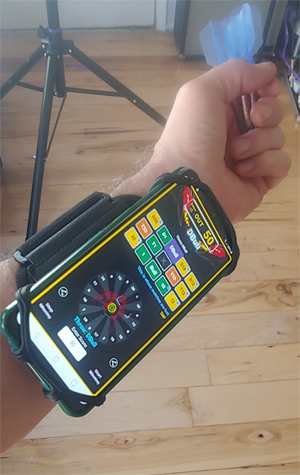
120 Checkout in Darts — T20, 20, D20
At 120, the leg is decided by the quality of the opening throw more than any other single factor. The route — T20 → 20 → D20 — is built to convert that first dart into a clear path to D20. Players who finish 120 reliably treat the opening triple as the highest-consequence dart in the visit, not the double — because the double becomes straightforward when the approach is controlled, and becomes genuinely hard when it is not.
The preferred miss direction on T20 from 120 is toward 5. Landing there leaves 115 — a position that still carries a realistic path to the close. The 1 side leaves 119 and a harder problem. Players who pay attention to miss geometry on their primary scoring targets consistently produce better outcomes from imperfect darts, which is where most of the marginal gains in competitive 501 are actually found — not in perfect throws, which are the same for everyone, but in where the imperfect ones land.
Players who are reliable at finishing 120 in competition have usually identified and eliminated one specific failure pattern from their game: the tendency to respond to what just happened rather than commit to what comes next. If the first dart misses, the instinct is to adjust — to be more careful, to aim more precisely, to compensate. That instinct is the source of most dropped legs on 120. The route provides the continuation from any reasonable first-dart outcome. Trusting the route rather than overriding it mid-visit is the discipline that converts practice form into match results.
Slowing the walk to the oche is not a technique — it is a way to create a moment for the grip to settle and the breath to normalise before the arm goes forward. Finishing 120 reliably in match play is a trainable skill. Players who build it deliberately — through structured pressure practice rather than hoping for composure — outperform those who rely on natural calm. The focus on 120 should be on setting the route cleanly, not forcing an early finish. Patience at this score is a genuine competitive advantage. Pressure affects the mind first and the arm second. Managing it means keeping the routine consistent so the arm stays unaffected. Grip pressure and arm speed are the two variables that pressure changes most reliably. Monitoring both before stepping to the oche gives the player a real point of intervention.
With the opponent on a finish, T20 from 120 carries double weight — it scores efficiently and tells the opponent that this leg is not over. D20 as the close is the ideal target to be arriving at under those conditions.
Route Comparison & Target Selection
Primary: T20 → 20 → D20
treble 20 (60), single 20, closing on double 20 — high-percentage close
On 120, 1 is the anti-target. Drifting into it leaves 119 rather than the more manageable 115 from 5.
Miss Geometry, Route Structure & When to Use the Alternate
Treble 20 is flanked by the weakest neighbour pair on the board — 5 to the left and 1 to the right. Those two segments are the lowest-value singles in darts, which means any drift off the treble from 120 costs real scoring value and can leave an awkward continuing position. A miss toward 5 produces 115 remaining; toward 1, 119. Neither is a catastrophe, but neither gives the same clean route that landing treble 20 provides. The geometry here is working against you on both sides, which is precisely why the switch to treble 19 becomes the correct structural call when grouping drifts consistently below the bed. The 19 is flanked by 3 on one side and 7 on the other — both score more than 1 or 5, and both more often preserve a clean three-dart route into a finish. The switch is not a concession when drift is present. It is the geometrically stronger decision. In terms of the dart count and sequence, the route from 120 runs three darts because no scoring dart from here leaves a direct two-dart finish available. T20 creates the initial scoring position, 20 moves into the exact finish window, and D20 ends the leg. Each dart has a specific job in the sequence, and the route collapses when any one of them is thrown to the eventual close rather than to its immediate role. Particularly on 20 — the bridging dart — there is a tendency in match conditions to rush toward the double before the position has been properly set. That tendency produces worse averages on three-dart finishes than on two-dart ones, despite the extra dart. The fix is committing fully to 20 before thinking about D20.
When and Why to Use This Route
This is the route to back when the match is tight. T20 scores efficiently and D20 is one of the most forgiving closing doubles in 501. The structure does not require a perfect opening dart — it holds up even when T20 misses slightly, because both neighbours still leave workable positions.
This route is effective at every level of match pressure because both of its components are independently strong. T20 is an efficient opener that scores well even on a slight miss into either neighbour. D20 is one of the best finishing doubles in 501 — it splits cleanly when missed and gives a strong recovery position. When both darts land where they should, the leg closes. When one of them drifts, the visit is usually still recoverable.
Why Players Miss This Finish
Players miss 120 because they bring a two-dart mindset to a three-dart route. When T20 lands well, the impulse is to jump mentally to the close — to start aiming at D20 before 20 has landed. That forward projection reduces the quality of 20 in exactly the same way that thinking about the result of any throw reduces the quality of that throw. The fix is discipline on the middle dart: throw 20 as its own complete decision, with the same focus given to T20, and only then address D20.
Improving on 120 in competition comes from accepting that the throw will not always be perfect and building an automatic response to imperfection. The players who drop this score are usually players who need everything to go right. The players who close it are the ones who have practised enough variants of the route — clean first dart, slightly off first dart, both miss directions — that the visit runs on autopilot regardless of the opening outcome.
Practice
Build the 120 checkout through the middle dart. T20 and D20 receive most of the practice attention in most players' routines — T20 because it opens the visit and D20 because it closes it. But on 120, 20 is usually where the leg is won or lost. A clean T20 that is followed by a slightly rushed 20 leaves D20 from a weaker position than the route intended. Give 20 deliberate practice in isolation — it is the least-practised dart in most three-dart routes and the one that determines whether the close is routine or difficult.
Add consequence to the end of every 120 practice block. After completing the route a set number of times cleanly, throw T20 deliberately off-line and practise continuing from 115 and 119 without resetting. This forces the continuation habit — the automatic response to a miss on the opener that keeps the visit running rather than stalling. Players who have practised their recovery positions finish more legs from imperfect visits than those who only ever practise the clean route.